
QUT Professor Endorses UK Push To Create Smokefree Generations
QUT Media4th November 2025 The United Kingdom Parliament is considering a bill aimed at making smoking obsolete, which has been

Joshua Yuvaraj, Author’s Interest Project, (CC-BY-ND) Link
We’re delighted to announce that our latest research, a whole-of-universe study of copyright termination notices constructed from the US Copyright Office’s online catalogue, has been accepted for publication in the Journal of Empirical Legal Studies. Led by Joshua Yuvaraj and Rebecca Giblin of the Melbourne Law School, in collaboration with the Melbourne Data Analytics Platform and Associate Professor Genevieve Grant at Monash University, this is the first in-depth look into the real-world use of the U.S. copyright termination system.
This research examines Copyright Office records created each time someone files a notice of termination under §§ 203 or 304 of the Copyright Act. Those sections grant authors and their heirs inalienable rights to end copyright grants and reclaim their rights 35 years after transfer. They were designed to give authors a ‘second bite’ of the cherry, giving some redress in situations like that involving the co-creators of Superman (who sold their rights for just $130 in 1938). We constructed new open access datasets that contain all the termination notices we could locate in the catalog. Our research also analyses who is filing such notices and for what types of work, and how publishers, record companies, and other intermediaries respond when notices are filed against them.
Our data and analysis will inform ongoing discussions around the world for stronger creator protections in copyright law. In the EU, Canada, and South Africa, lawmakers have either recently implemented or are considering implementing new reversion rights (provisions giving authors entitlements to reclaim their rights). These proposals are meant to push back against often one-sided rights contracts authors often find themselves in, across a range of creative industries, and promise benefits to book authors, recording artists and songwriters among others. Reversion rights have great potential to help better achieve copyright’s goals: to reward authors for their creative labour and to incentivise ongoing access to creative and informational works.
Until now however, there’s been a gaping hole in these discussions: a lack of data on how existing reversion rights actually work in practice. This is critical to designing rights that will best achieve their aims. One of the most interesting reversion schemes is the US statutory termination rights outlined above. Unlike most others, these have a registration requirement. Studying the notices that are lodged with the US Copyright Office opens up new ways of understanding how these rights actually operate in the wild – and offers important lessons to policymakers elsewhere.
We created two new datasets of all termination notice records from the Copyright Office Catalog: one for § 203 (dealing with post-1978 works) and one for § 304 (dealing with pre-1978 works). Using a custom-built web scraping tool using Python, we extracted data from records of termination notices on the Catalog.
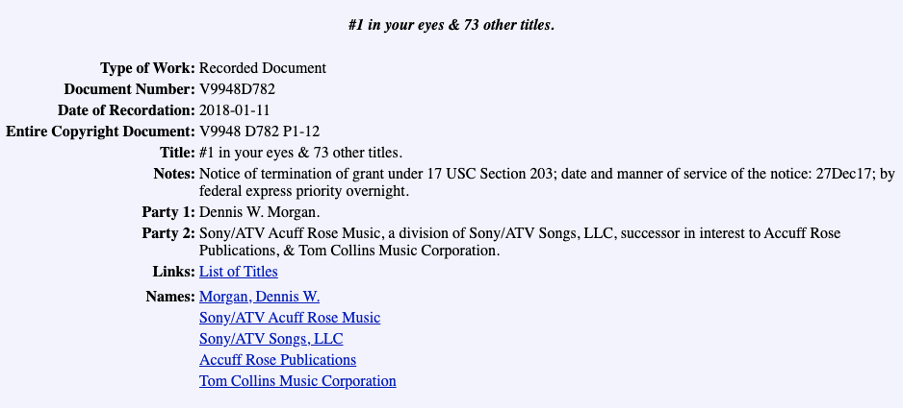
We then converted the data into analysable format – something that isn’t possible on the Catalog itself. This is eliding a lot of detail – the collection and cleaning exercise was mammoth. However, now that it’s done, and our datasets are openly available, it opens up the possibility of all kinds of new analysis and insight into what’s actually happening.
Our initial analysis only scratches the surface of this data, and we invite interested folk to dip into the datasets themselves to see what they can find. Having said that, here are some of the trends we found:
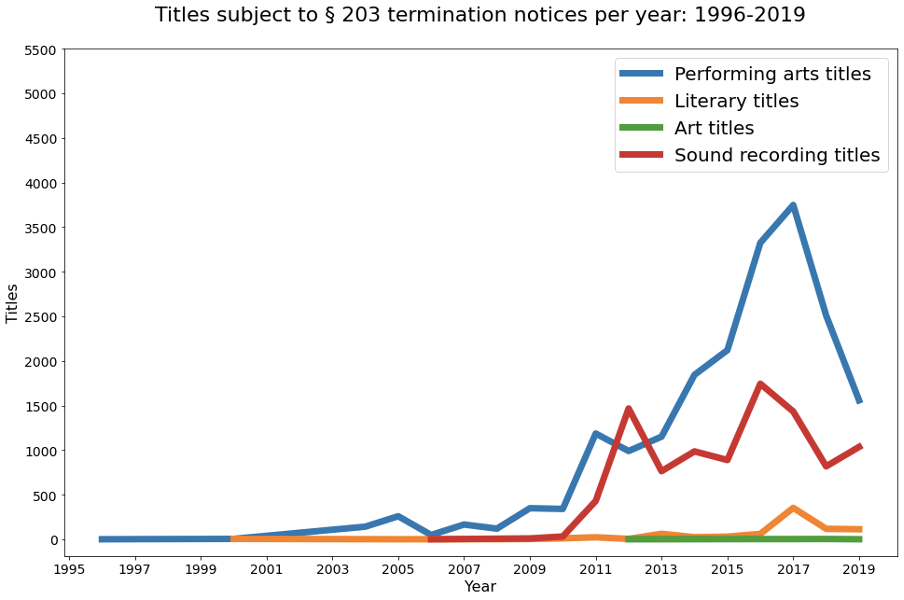
The pre-print of our paper can be downloaded here, and our datasets and codebooks can be downloaded here and here respectively. Please dig in, and if you find cool stuff, let us know!

QUT Media4th November 2025 The United Kingdom Parliament is considering a bill aimed at making smoking obsolete, which has been
Speaking at the Global Expert Network on Copyright User Rights Symposium on 16 June 2025, Professor Christophe Geiger argues for
On 25 September 2025, Professor Wend Wendland, delivered the 14th Peter Jaszi Distinguished Lecture at American University in Washington D.C..
On September 18, 2025, the Italian Senate definitively approved the country’s first comprehensive framework law on artificial intelligence (AI). The
Por Andrés Izquierdo Durante la segunda semana de agosto, fui invitado a hablar en la Feria Internacional del Libro de
By Andrés Izquierdo AI, Copyright, and the Future of Creativity: Notes from the Panama International Book FairDuring the second week