
Background
The Global Congress is the largest and most important international convening of academics and advocates working at the intersection of intellectual property law and the promotion of the public interest. The core goal of the Congress is to promote evidence-based policy-making by fostering partnerships between academics and policy advocates from around the world. The specific policy goals of the Congress were summarized the 2011 Washington Declaration on Intellectual Property and the Public Interest.
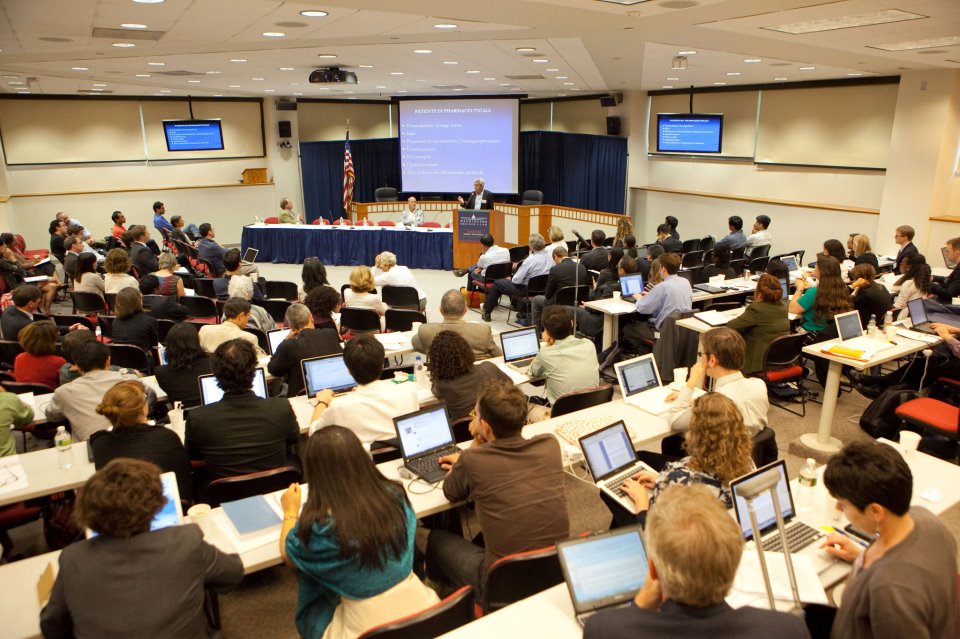
This year’s Congress will feature several days of by-application-only training, action, and strategizing before a multi-day public conference webcast to the world.
Prior Meetings
The Global Congress was launched at AUWCL in 2011, where it produced the Washington Declaration on Intellectual Property and the Public Interest.
Subsequent Congress meetings were hosted by Centro de Tecnologia e Sociedade, FGV Direito, Rio de Janeiro, Brazil, by University of Cape Town IP Unit, Cape Town, South Africa, and by the Centre for Internet and Society, New Delhi, India.
Each Congress takes stock of new research and advocacy priorities and publishes an agenda for promoting evidence-based intellectual property and information policy.
There are over 800 policy advocates and academics from over 80 countries who have attended at least one prior Congress and remain a member of its distribution list.
Planning Partners
The Fifth Global Congress will be planned by a team of partners. For the current list of partnering organizations who have proposed to lead at least one presentation, click here.
Methodologies
Agenda Setting Exercise with Polis
This year the Congress will use a new social research platform — Polis – to engage participants in a week-long participatory planning exercise in relation to these core questions of the Congress. All Members of the Congress will be given access to the platform, and sessions will be encouraged to use the platform to record insights from their discussions. The Polis platform permits Members to register their views and vote on others’ suggestions. Congress sessions will be encouraged to engage the Polis platform. The outcome of the exercise will be a report on what the platform participants were our community’s highest priorities for our work ahead.
Capacity Building Workshops and Trainings
We are reserving spaces at AUWCL, Georgetown Law and Public Citizen for Pathways to sponsor capacity building and training programs. Monday September 24 will be a designated training day, particularly for full or half day trainings and during the public sessions of the Congress.
Action and Engagement
Action and engagement meetings seek to get participants out in the field to get work done. Examples include meetings with government officials, Congressional staff, industry or other stakeholders, etc. These activities will generally take place on Tuesday September 25.
Project Workshops
The Congress will provide opportunities for research and advocacy projects to meet, engage in planning, review products and outcomes and obtain feedback from other Congress members.
Networking Receptions
We will have slots for sponsored networking receptions every evening. The early periods will be primarily targeted toward policy advocate mixers with U.S. stakeholders and government officials. Receptions during the public event may take place at AUWCL or downtown and will have greater numbers of academics.
Pathway Committee Meetings
Pathway Committee Meetings may be held during the Congress to undertake drafting and decision making, such as for proposed resolutions and plans of action for the Congress.
TED-Style Talks
During the public sessions, we will have rooms running continuous TED style talks webcast live and on demand.
Scholarly Proposals “Shark Tank”
We invite intellectual property scholars to present a policy proposal from their research to a panel of global public interest advocates.
Presentation times will be strictly limited to 12 minutes with 8 minutes reserved for questions from a “Shark Tank” panel of advocates in the field.
Applicants will be requested to submit a published or unpublished article on which the proposal is based for publication in an online repository accessible by Congress participants and the public. New work will have opportunities for publication in the American University International Law Review and the online American University IP Brief.
Panel Discussions
Panel discussions will be hosted during the public sessions of the Congress. Panels can be proposed by Panel Sponsors (see below) or constructed by the Pathway Committees from applicants from the call for presentations.
Works-in-Progress Workshop (may be by application only)
Works-in-progress workshops give scholars and others opportunities to obtain feedback on draft written work from peers.
Plenary Keynotes
We will reserve the final slot of each day during the public sessions for keynote lectures or panel discussions with leaders in the field.
General Assembly
The final formal activity of the Congress will be a General Assembly. At the Assembly, we will have a report of the Polis Agenda Setting platform and will consider resolutions and statements from the Pathways for endorsement.
Pathways and Focus Areas
The Global Congress will be organized into Pathways (what we used to call “tracks”) of events and activities around major themes.
There will be two major Pathways representing the ends of public interest intellectual property policy — Knowledge and Creativity; and Health, Environment, Innovation & Research and Development.
Within each Pathway, there will be a series of more defined Focus Areas, often corresponding to particular means (e.g. user rights) or ends (e.g. access to medicines) of public interest intellectual property policies.
Knowledge and Creativity
User Rights
- How copyright user rights can play a key role in breaking down barriers to full participation in the digital economy.
Openness
- How intersections between intellectual property and open access, data and science policies can promote a rich public domain of content, data and tools that are free from copyright control.
Enabling Education & Research
- The means and ends of overcoming copyright, patent and other legal barriers to goals-driven education and to the production of and access to high quality scholarly research.
Trade and Internet
- How “E-Commerce” provisions in trade agreements impact digital rights and freedoms? What can be done to tackle the challenges presented by trade agreements? How can we make digital rights sustainable in trade agreements?
Health, Environment, Innovation & Research and Development
Access to Medicines
- How law and policy can be reshaped to expand the production of and access to quality, affordable medicines and health technologies for all.
Open Science and Data
- How policy and licensing solutions can overcome barriers to innovation that patents and other forms of exclusion can sometimes cause.
R&D Incentives
- How law and policy can promote better research and development investments by both government and private actors.