
QUT Professor Endorses UK Push To Create Smokefree Generations
QUT Media4th November 2025 The United Kingdom Parliament is considering a bill aimed at making smoking obsolete, which has been

Teresa Nobre, Reposted from Education International, Link (CC-BY-NC)
Access to knowledge is an important aspect of the right to education. In order to respond to the needs in the classroom, teachers often complement traditional teaching resources (e.g., textbooks and other curated materials) with a wide spectrum of materials from a variety of sources (e.g., short videos, images, articles). These are often protected by copyright and related rights [1].
Recognising the essential public mission of education as well as the right of teachers to choose and adapt teaching materials without having to ask permission from the copyright owner, governments are putting in place so-called copyright exceptions and limitations for education. Unfortunately, the COVID-19 pandemic and the massive shift to remote education during school closures has highlighted, more than ever before, that those exceptions and limitations are not always fit for teaching in the digital age.
Is it Legal? Education and Copyright in the Digital Age analyses 10 digital and remote teaching and learning scenarios that involve the use of copyrighted materials and other protected materials under the laws of 40 countries in Africa, Asia-Pacific, Europe and North America, and Latin America and the Caribbean.
This study’s findings indicate that, in many countries, current copyright laws prevent the use of copyrighted materials in remote educational activities (e.g. live-streamed online or radio-broadcasted classes) and in on-demand digitally-supported education (e.g., emailing or storing reading materials on a school’s platform). This forces teachers to either refrain from using such materials or to work in legal grey zones.
Here are some of the patterns and trends identified in the study, which illustrate the inequalities between the regions and can provide guidance for copyright reform efforts:
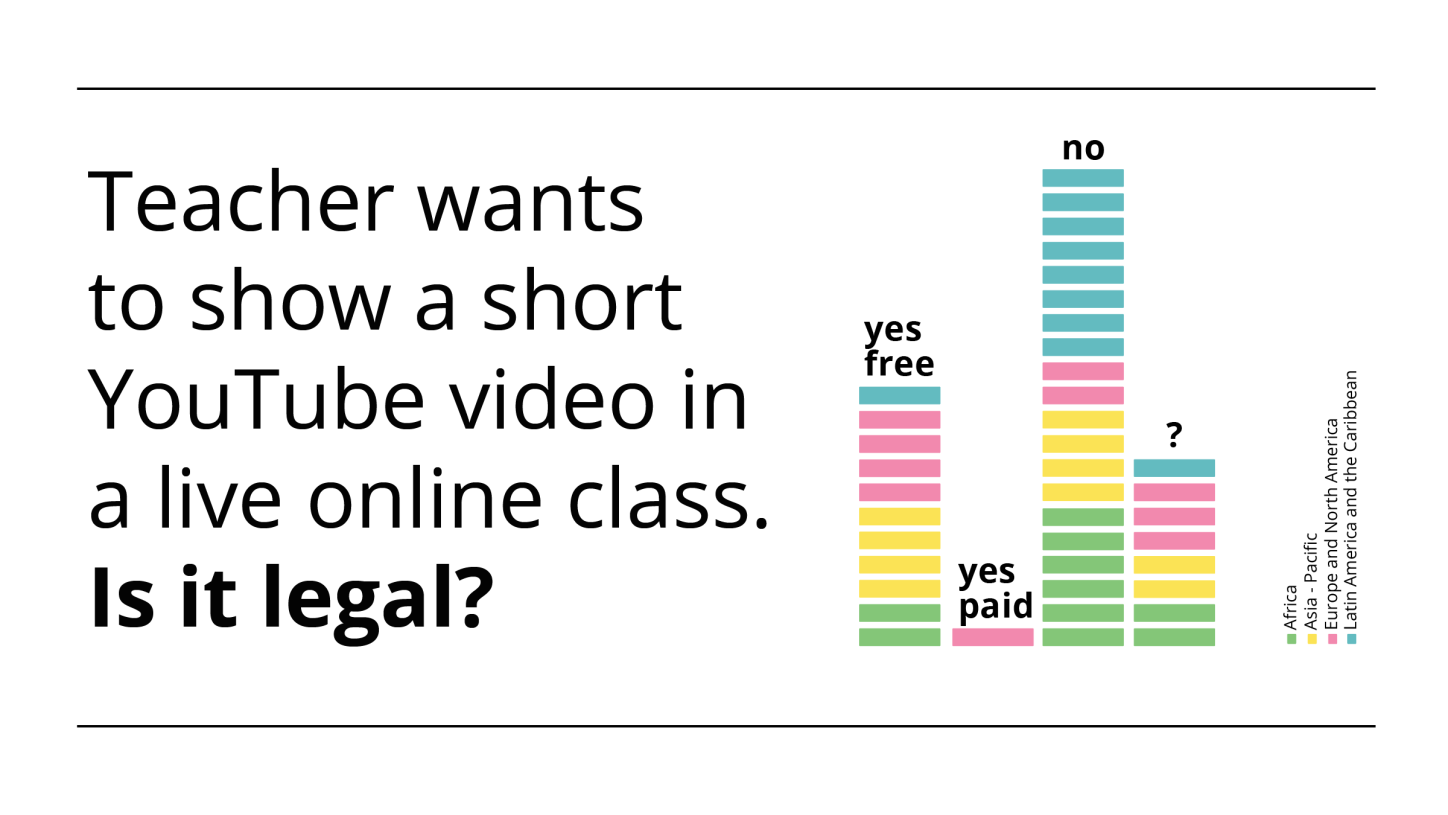
This scenario illustrates the digital copyright divide well. In contrast to countries in the Global North, countries in Latin America and Africa in particular do not perform well in this scenario. They do not permit distance communication/sharing of protected materials.
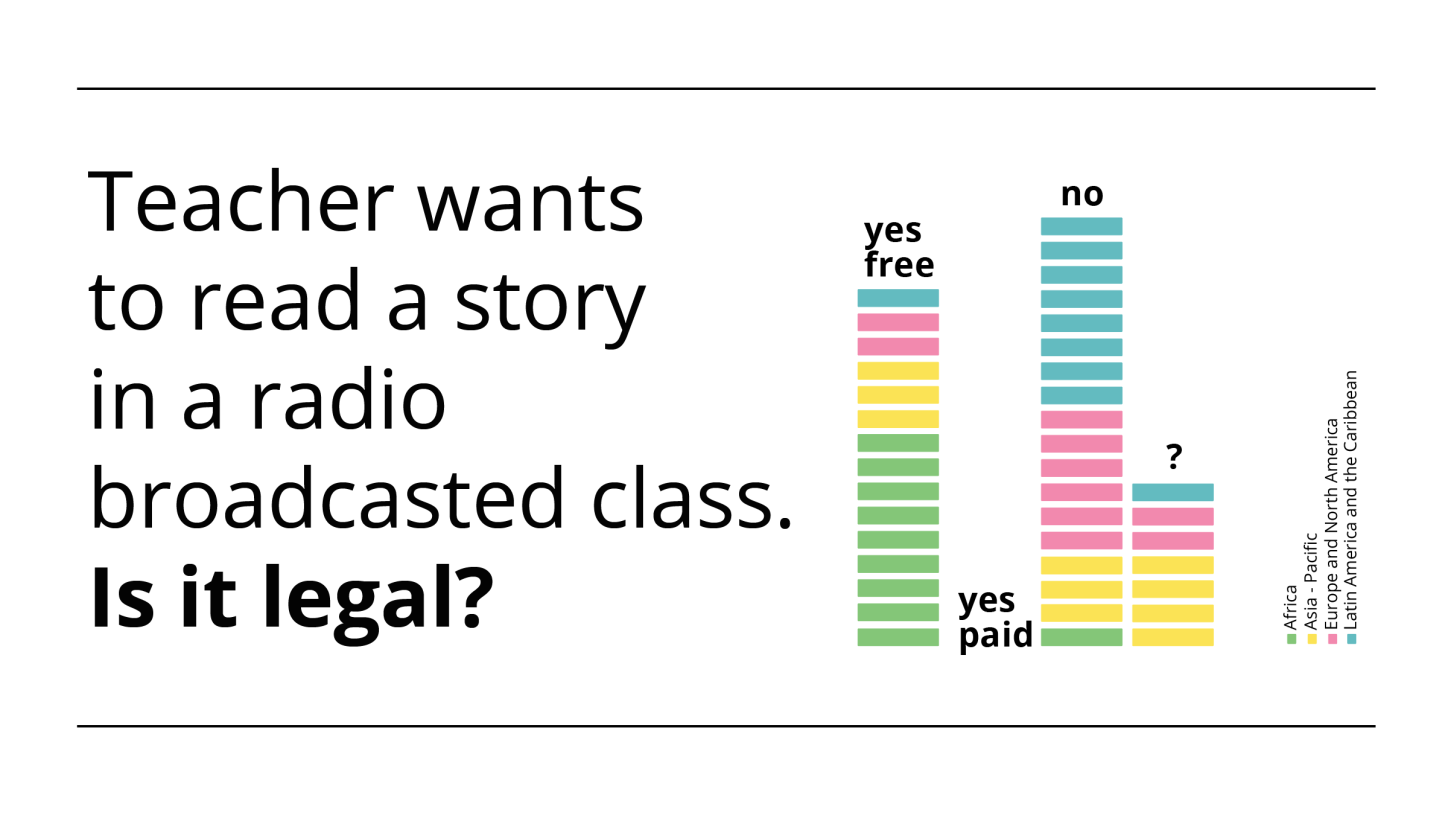
This scenario illustrates the role played by international model laws. In Africa, in contrast to other regions, most legal frameworks are supportive of uses of protected materials made during radio-broadcasted classes. This is because most have been influenced by the educational exception model contained in the 1976 Tunis Model Law, which specifically exempts “the utilization of a work by way of illustration in … broadcasts”.
As the world is dramatically “off track” in terms of achieving the Sustainable Development Agenda for Education, it will be essential for governments to take action now:
The full research paper by Nobre, T. (2022) can be found here : https://eiie.io/3PdfYEW
The summary of the research can be downloaded here: https://eiie.io/3LX8FyU
Note:
[1] “Copyright” refers to exclusive rights granted to the author of a work; “Related rights” refer to exclusive rights granted to certain categories of people (e.g., performers such as actors and singers, producers of sound recordings and films, broadcast organisations) in respect of the materials they produce.

QUT Media4th November 2025 The United Kingdom Parliament is considering a bill aimed at making smoking obsolete, which has been
Speaking at the Global Expert Network on Copyright User Rights Symposium on 16 June 2025, Professor Christophe Geiger argues for
On 25 September 2025, Professor Wend Wendland, delivered the 14th Peter Jaszi Distinguished Lecture at American University in Washington D.C..
On September 18, 2025, the Italian Senate definitively approved the country’s first comprehensive framework law on artificial intelligence (AI). The
Por Andrés Izquierdo Durante la segunda semana de agosto, fui invitado a hablar en la Feria Internacional del Libro de
By Andrés Izquierdo AI, Copyright, and the Future of Creativity: Notes from the Panama International Book FairDuring the second week