
QUT Professor Endorses UK Push To Create Smokefree Generations
QUT Media4th November 2025 The United Kingdom Parliament is considering a bill aimed at making smoking obsolete, which has been

Michael Palmedo
This post describes the newly released Global Innovation Index and PIJIP’s ongoing research into copyright exceptions for research. It then presents correlations between subsets of the Global Innovation Index data and PIJIP’s categorization of copyright laws.
Last week, WIPO launched the 2022 Global Innovation Index (GII), which ranks 132 countries according to 81 indicators related to innovation. It finds that global R&D has continued to boom, but that productivity growth has stagnated. But beneath the top line findings is a lot of interesting data on innovation inputs and outputs.
The 81 indicators are grouped into seven broad “pillars”. These are Institutions; Human capital and research; Infrastructure; Market sophistication; Business sophistication; Knowledge and Technology outputs; and Creative outputs.
For the last few years, PIJIP has been analyzing the copyright exceptions for researchers in the copyright law of each WIPO Member state. Specifically, we have reviewed the laws of over 200 countries to see the degree to which they “have a research exception in their law that is sufficiently open to be able to permit reproduction and communications of copyrighted work needed for academic text and data mining (TDM) research.”
In Research Exceptions in Comparative Copyright, by Flynn et. al. (2022) we use this six-point scale to classify the exceptions’ openness:
The paper linked above describes this classification in more detail.
If the strength of copyright exceptions for researchers is associated with other innovative inputs and outputs, then we should be able to see correlations between PIJIP’s classification of countries’ laws, and some of the pillars found in the GII.
The GII pillar “Human Capital and Research” is a grouped average of the following indicators that measure innovative inputs:
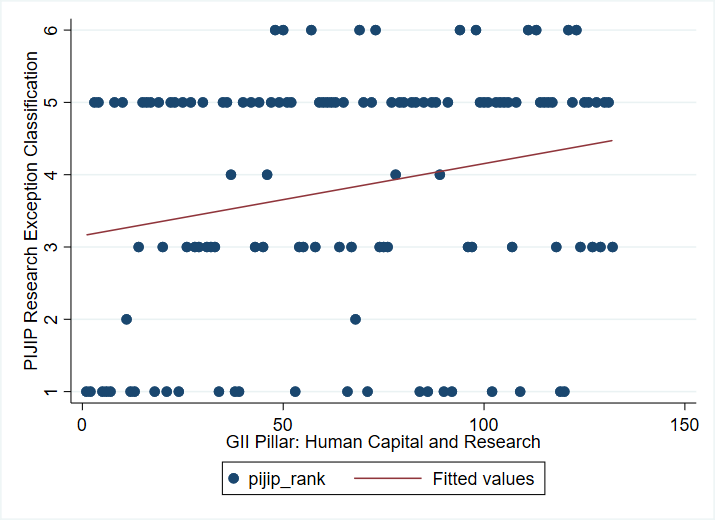
The GII ranks countries according to this pillar on pages 50-5 of the report, with Korea ranked #1. Figure 1 shows the positive correlation between the ranking of countries by this pillar, and PIJIP’s classification of countries’ research exceptions. This positive correlation implies that countries with a stronger focus on education and more researchers tend to have copyright exceptions with a greater degree of openness.
The GII pillar “Knowledge and Technology Outputs” is a grouped average of the following indicators measuring outputs of innovative processes:
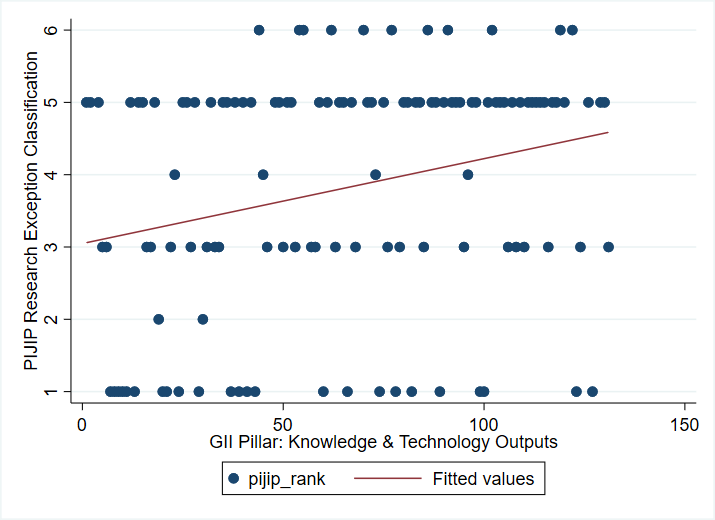
Switzerland is the top-ranked country for this measurement of Knowledge and Technology Outputs. As shown by Figure 2, PIJIP’s categorization of countries’ copyright exceptions for research is positively correlated with the GII rankings for this pillar. The association implies that countries with stronger copyright exceptions for researchers produce a more innovative output (relative to total output) than countries with weaker exceptions.
Together, these correlations show that the way research exceptions are crafted is associated with real-world variables related to innovation.
As we further develop this line of research, we plan to use the data in a series of empirical experiments. We are currently working with law students to track changes in countries’ copyright exceptions over time in order to produce studies that are more detailed, and more able to find causal relationships.

QUT Media4th November 2025 The United Kingdom Parliament is considering a bill aimed at making smoking obsolete, which has been
Speaking at the Global Expert Network on Copyright User Rights Symposium on 16 June 2025, Professor Christophe Geiger argues for
On 25 September 2025, Professor Wend Wendland, delivered the 14th Peter Jaszi Distinguished Lecture at American University in Washington D.C..
On September 18, 2025, the Italian Senate definitively approved the country’s first comprehensive framework law on artificial intelligence (AI). The
Por Andrés Izquierdo Durante la segunda semana de agosto, fui invitado a hablar en la Feria Internacional del Libro de
By Andrés Izquierdo AI, Copyright, and the Future of Creativity: Notes from the Panama International Book FairDuring the second week