
Category Multilateral Fora

Marrakesh in Action: History Is Made in Kyrgyzstan

[EIFL press release] EIFL (Electronic Information for Libraries) and the University of Toronto (U of T) Libraries are proud to announce the first international transfer of accessible format books to beneficiaries in Kyrgyzstan. The transfer, that took place on the occasion of a National Seminar with the IP Office of Kyrgyzstan on the Marrakesh Treaty on World Book and Copyright Day, was in response to requests from two beneficiaries: Dastan Bekeshev, a lawyer and member of parliament (MP) who lost his sight at six years of age, and Gulnaz Juzbaeva, an MBA student at the American University of Central Asia (AUCA) who was born with low vision and later became blind.
Rising Middle-IP Powers Dissolving the North/South Polarisation in the International IP System

[Ruth Knoblich and Tobias Schonwetter] Academia and the public have long been focusing on the North/South power asymmetries in the international IP regime. Two decades after the Agreement on Trade-Related Aspects of Intellectual Property Rights (TRIPS) came into effect at the beginning of 1995, it is now becoming obvious, however, that rising economies such as Brazil, India, China and South Africa emerge as a cross-cutting group of players that may help, going forward, to dissolve the North/South polarisation in the international IP order. Firstly, these countries make full use of the existing international IP system: They design their national IP law in compliance with the TRIPS minimum standards for protection, while counterbalancing these standards by strategically utilising (and testing the boundaries of) the TRIPS flexibilities available to them. Secondly, emerging economies have also begun to successfully influence the international system of IP law and policy-making itself to better reflect their interests and needs.

Intellectual Property before the European Court of Human Rights

[Christophe Geiger and Elena Izyumenko] Abstract: In the past years, the European Court of Human Rights (ECtHR, or Strasbourg Court), Europe’s principal human rights watchdog, has played an ever larger role in the resolution of intellectual property (IP) disputes. The ECtHR’s engagement in IP adjudication has already influenced national judges, who increasingly have recourse to human rights to solve cases between private parties, thus calling for closer scrutiny of the Court’s practice on this matter. The present chapter provides the first comprehensive overview of the ECtHR case law on IP for the period since the Court’s inception (in January 1959) until today (February 2018).

EIFL RESPONDS TO IRISH MARRAKESH CONSULTATION

[Electronic Information for Libraries] In December 2017, the Irish government issued a public consultation on transposition into national law of European Union (EU) Directive 2017/1564 implementing the Marrakesh Treaty for persons with print disabilities. Irish transposition of the Directive could serve as a model not only for other EU member states, but also for EU candidate countries and potential candidates.

How Closed Trade Deals Ratchet Up the Copyright Term Worldwide

[Jeremy Malcolm] ... differences in copyright term make things more complicated for copyright holders, there are constant efforts by some copyright holders to try to homogenize the duration of copyright so that they can more easily enforce their copyrights worldwide—and of course, they would like them to be harmonized at the life-plus-70 year term, so that they can extract another 20 years of monopoly rents, over and above the Berne Convention's standard life-plus-50 year term. Trade agreements are one way that they are trying to achieve this.

Keeping Up With International Approaches: South African Copyright Limitations and Exceptions for Educational Activities

[Charlene Musiza]  The 35th session of the Standing Committee on Copyright and Related Rights (SCCR) took place at the World Intellectual Property Organization (WIPO) at the end of last year. Comprising of all members of WIPO, the SCCR analyses matters relating to the substantive law or harmonisation of copyright and related rights, and formulates recommendations.  Current issues the SCCR is addressing include the protection of broadcasts and broadcasting organisations as well as copyright limitations and exceptions. With regard to limitations and exceptions the focus is now on three areas: educational activities, libraries and archives and disabled persons. At the 35th session of the SCCR, UCT’s Professor Caroline Ncube presented, together with Professor Blake Reid from the University of Colorado, an important scoping study concerning access to copyrighted works by persons with disabilities.

The defense of education at the World Intellectual Property Organization

[Teresa Nobre, Communia Association, Link (CC-0)] As we reported last month, Communia attended the 35th session of WIPO’s Standing Committee on Copyright and Related Rights (SCCR), which took place from 13 – 17 November in Geneva. The SCCR has a mandate to discuss limitations and exceptions to copyright, including for educational purposes. While Communia supports efforts to reach minimum international standards of exceptions and limitations to copyright in all the different areas that are currently under discussion (libraries, museums, archives, persons with disabilities, and education), our role there is specifically to support the dialogue on educational exceptions.

NGOs Banned from WTO Ministerial

At this year’s WTO ministerial there will be debates about adopting a new E-Commerce agenda to regulate Internet trade – but one of Latin America’s leading NGOs working on the issue is not allowed to go.

Call on Asia-Pacific Region: Join Marrakesh Treaty

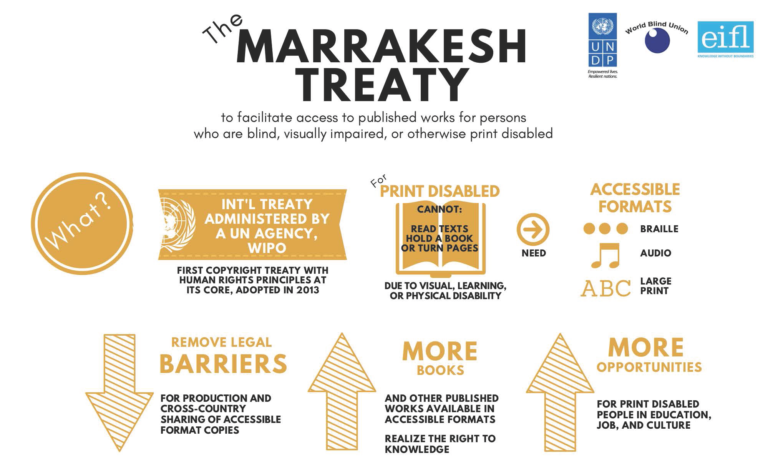
[Electronic Information for Libraries, Link (CC-BY)] To mark the International Day of Persons with Disabilities on 3 December, three global organizations, the United Nations Development Programme (UNDP), the World Blind Union-Asia Pacific (WBUAP) and EIFL developed an Issue Brief for…

WIPO Broadcast Treaty Turns to Limitations and Exceptions

At the latest meeting of the WIPO Standing Committee on Copyright and Related Rights, there was new movement on copyright limitations and exceptions. Argentina and Brazil tabled language that adds more specificity to the limitations and exceptions that may be…