

QUT Professor Endorses UK Push To Create Smokefree Generations
QUT Media4th November 2025 The United Kingdom Parliament is considering a bill aimed at making smoking obsolete, which has been

 Case Study: Copyright Debate in Estonia
Project Manager: Karmen Linask
Copyright Specialist, National Library of Estonia
Results of an EIFL-IP funded project (Link) [CC-BY]
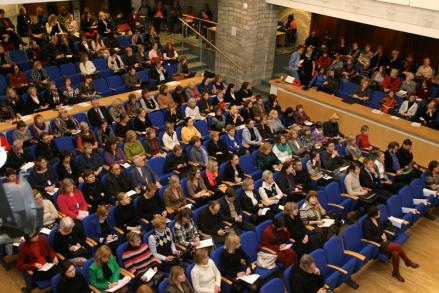
In January 2013, libraries in Estonia took to the national airwaves with “Digital Memory”, a capacity-filled seminar where libraries presented their newly developed position on copyright as part of a national debate on the copyright law. Members of the Expert Group on the Codification of the Intellectual Property Law (IPC Working Group), government officials, libraries and other memory institutions, authors, publishers, and lawyers were among the 300 attendees at the public event that, in a first for libraries, featured on the Estonian National Television main evening news and on Vikerraadio, the national radio station.
‘The EIFL-IP project has enabled the library community to take the first steps towards formulating a unified position on copyright issues, and to ensure a single, strong library representation for the drafting of the new copyright law. We hope that the voice of libraries will be listened to more in the future. Joined forces are power!’ Karmen Linask, Project Manager
The Copyright Act of 1992, enacted following the re-establishment of Estonian independence, was considered to be one of the most modern copyright laws of its time. Since then, Estonia has undergone many legal, political and technological changes. Internal legal reforms on the penal code and private law, for example, were completed. Estonia, the most northerly of the Baltic states, joined the European Union in 2004, and today ranks among the most wired and technologically-advanced countries in the world.
During this time, the Copyright Act has changed 31 times. The result is that the structure of the law is unwieldy, it has become hard to understand and many parts are out of date. Within the framework of an EU-funded programme, “Development of Better Legislation”, Estonia is in the process of revising its intellectual property laws. To this end, the Ministry of Justice has established an Expert Group on the Codification of the Intellectual Property Law (IPC Working Group) that is expected to complete its task – and the drafting of a new copyright law – by September 2014.
‘The Working Group is interested in getting input from all stakeholders. We are particularly happy that libraries are actively involved in the consultation process. As public institutions with a professional interest in copyright, libraries have a crucial role in any national, regional and international debate on a new copyright law.’ Aleksei Kelli, head of the IPC Working Group
The project partners were the National Library of Estonia, the Consortium of Estonian Libraries Network (ELNET) and the Estonian Librarians Association. The project goals were to:
The expected result is that all stakeholders including libraries, government authorities, creative industries and users will have a clearer understanding of library copyright issues, and that workable solutions will be devised for Estonian libraries.
✓ Library copyright expertise was built up and cooperation strengthened. A Library Copyright Working Group with representatives from six major libraries (National Library of Estonia, Tallinn Central Library, Academic Library of Tallinn University, University of Tartu Library, Tallinn University of Technology Library, Repository Library of Estonia) was set up to improve cooperation and to formulate a joint position on library copyright issues. The group met 5 times each with a different focus: general copyright, lending of AV works and e-books, orphan works, future action plan.
✓ Libraries formed new alliances that will benefit into the future. The Library Copyright Working Group established cooperation with the IPC Working Group, the Ministry of Justice and other stakeholders including the National Archives and the Estonian Public Broadcasting organization on areas of common interest, such as orphan works.
✓ With support from a copyright lawyer, suggestions for amendments to the Estonian Copyright Act were drafted (in Estonian) and submitted to the IPC Working Group. Proposals include new exceptions to permit the lending of audiovisual works by libraries; copying of e-books for preservation; text and data mining for core library functions such as bibliographies; clear rules for orphan works; protection of exceptions and limitations from override by contract terms.
✓ The project succeeded in bringing different stakeholders together to arrive at a greater understanding on areas such as e-books. In the lead-up to the final seminar, there was a heated debate about the demise of print publications, yet the discussion showed a different reality where authors and publishers are reluctant to make the switch, very restrictive usage terms are imposed on libraries, and higher VAT on electronic publications mean pricing issues.
✓ Libraries received extensive media coverage and positive attention from the general public.
The project was presented at events attended by more than 430 participants:
The Project Manager will present “Digital collections and legal challenges in Estonia” at the conference eBooks on Demand in June 2013 (Tartu).
National media coverage
A special article about the the library proposals and project final seminar will be published in Raamatukogu – a professional library journal – in April 2013.
Online promotion
The project began an active collaboration among libraries on copyright. We hope that the Library Copyright Working Group will continue its work through ELNET (Consortium of Estonian Libraries Network). With a set of concrete proposals and participation in the copyright review process, libraries are in a stronger position than ever before to help ensure that the voice of libraries is taken into account, and that the new Copyright Act will meet the needs of libraries and users in Estonia.
EIFL-IP supported this project with a grant of €3,200.The project began in June 2012 for a duration of eight months. For more information, please contact the Project Manager, Karmen Linask at <karmen.linask AT nlib.ee>.
For information on other EIFL projects in support of national copyright law reform, visit www.eifl.net/advocacy-campaigns-national-copyright-law-reform

QUT Media4th November 2025 The United Kingdom Parliament is considering a bill aimed at making smoking obsolete, which has been
Speaking at the Global Expert Network on Copyright User Rights Symposium on 16 June 2025, Professor Christophe Geiger argues for
On 25 September 2025, Professor Wend Wendland, delivered the 14th Peter Jaszi Distinguished Lecture at American University in Washington D.C..
On September 18, 2025, the Italian Senate definitively approved the country’s first comprehensive framework law on artificial intelligence (AI). The
Por Andrés Izquierdo Durante la segunda semana de agosto, fui invitado a hablar en la Feria Internacional del Libro de
By Andrés Izquierdo AI, Copyright, and the Future of Creativity: Notes from the Panama International Book FairDuring the second week