
QUT Professor Endorses UK Push To Create Smokefree Generations
QUT Media4th November 2025 The United Kingdom Parliament is considering a bill aimed at making smoking obsolete, which has been

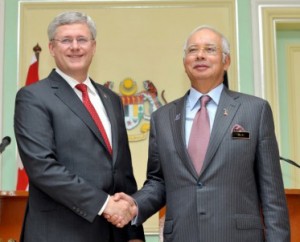
Today, Prime Ministers meeting in Bali in advance of this week’s APEC meeting expressed skepticism that negotiators will finalize a TPP deal by the end of the year. Malaysian Prime Minister Najib Razak told the press that “the end of the year is a very tight timeline. We will have discussions in Bali and we will have a sense whether that timetable is feasible but our sense is that it may take longer than the time horizon of the end of the year.” Canadian Prime Minster Stephen Harper agreed, saying “There will be a conversation about this among the heads of government who are present except for Mr. Obama and there has been progress, but as Prime Minister Najib said, the negotiators have much to still do.” (US Trade Representative Michael Froman was more upbeat. He told the press on Friday that “finish line is in sight.” President Obama cancelled his trip to the APEC summit due to the government shutdown and debt showdown in the U.S.)
Meanwhile, U.S. Chamber of Commerce President Tom Donohue has been arguing that it is more important to have a deal with strong IPR protections than to meet the deadline. In an October 1 speech in Tokyo, he said “Speed is important, but not without the right content. For example, let’s not forego the strongest possible intellectual property protections… Let’s not compromise on an investor-state dispute settlement mechanism that will allow independent third parties to adjudicate disagreements… it’s more important to get this agreement right than to get it right now.” On an interview with CNBC the day before, Dohanue made a similar point that the substance of the deal is more important to U.S. companies than the December deadline.
Progress has remained slow on the particularly controversial issue of IP and access to medicine. Inside U.S. Trade reports that little progress on was made at the IP intercenssional in Mexico that ended October 2: “Negotiators discussed pharmaceutical IPR for one day or less, and focused more on copyrights, geographical indications and enforcement… The U.S. did not come forward with a new proposal on this issue as some countries had expected, and also did not table a proposal on biologic drugs, sources said. Instead, the U.S. again explained to other TPP countries why its domestic law provides for 12 years of data exclusivity for biologic drugs, sources said, continuing an effort begun at the July round of negotiations in Malaysia.”

QUT Media4th November 2025 The United Kingdom Parliament is considering a bill aimed at making smoking obsolete, which has been
Speaking at the Global Expert Network on Copyright User Rights Symposium on 16 June 2025, Professor Christophe Geiger argues for
On 25 September 2025, Professor Wend Wendland, delivered the 14th Peter Jaszi Distinguished Lecture at American University in Washington D.C..
On September 18, 2025, the Italian Senate definitively approved the country’s first comprehensive framework law on artificial intelligence (AI). The
Por Andrés Izquierdo Durante la segunda semana de agosto, fui invitado a hablar en la Feria Internacional del Libro de
By Andrés Izquierdo AI, Copyright, and the Future of Creativity: Notes from the Panama International Book FairDuring the second week