
QUT Professor Endorses UK Push To Create Smokefree Generations
QUT Media4th November 2025 The United Kingdom Parliament is considering a bill aimed at making smoking obsolete, which has been

 [Reposted from oerpolicy.eu, Link, (CC-BY)] At the very beginning of October, Creative Commons’ OER policy project organised a two-day workshop in Porto, gathering 15 Open Education enthusiasts, educators, advisors, lawyers and experts on Creative Commons licensing. Apart from representatives from CC Sweden, CC Spain, CC Poland, CC Netherlands and of course CC Portugal, we were very happy to be able to reach out to other communities and have Rob from OER Research Hub present, as well as Ana and Ricardo from Journalism++, Eduardo who is conducting a PhD on OER, and last but not least from Heitor Alvelos, creator of the Future Places festival.
The event was the first official event organised by the “rebooted” CC Portugal, at the wonderful lab space of the Science and Technology Park of the University of Porto (UPTEC).
The workshop was organized at the end of the initial “OER Policy for Europe” project, with the goal of creating a basis for the continuation of our work. To this end, we decided to create a toolkit that can be used to organize a self-learning workshop on Open Educational Resources and policies that support them. With the help of the toolkit, we would like to ask OER enthusiasts to organize such workshops around the world, during the Open Education Week in 2015.
The toolkit, as we imagine it, should consist of following materials:
We’ve spent the first half-day on defining the concept of such a toolkit and the content needed for self-taught OER workshops to take place. As in every situation when over a dozen OER activists meet, we talked about definitions of open, avoiding flamewars on licensing choices, value- and benefit-based language. We imagined representatives of our target groups (having settled on academic librarians and school teachers), asked ourselves: why so few “do it”, if so many know about CC? and discussed policies as both barriers and enablers to sharing content.
Having settled the ideological debates, the participants quickly divided themselves into three groups, who continued to work on three specific pieces of content. One group worked on a leaflet explaining OER from the practitioners’ perspective, the second on policies – from the perspective of the barriers to openness that they remove, and the last on a scenario for a modular workshop on OER .
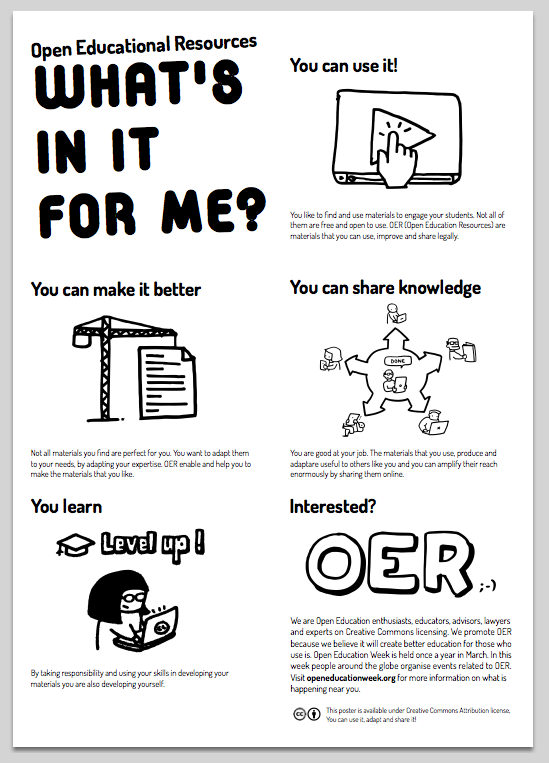
After a profound discussion on identifying stakeholders, the group decided to focus on three perspectives: of consumers, creators who don’t share, and creators who do share. After brainstorming pros and cons of sharing, we created the first version of a leaflet for educators. You can download it here (PDF).
This working group created a scenario for a workshop about OER. It was quickly decided to make the workshop modular, allowing for individual modifications based on particular wishes and experiences. The workshop would rely on existing resources as background material. We produced a model slidedeck with an outline of the workshop, together with an accompanying guidesheet for the persons leading the workshop
The last group tackled the challenge of finding a relatively simple way of describing OER policies. The general consensus among participants is that these are challenging issues to understand, and not necessarily important from a practicioner’s perspective. We nevertheless assumed that it is crucial to provide simple explanations for policies. To this end, we started with a list of barriers to the sharing and use of OERs; and defined policies (with examples) that help to remove them.
While our toolkit is still in an alpha version, we managed to come up with a concept of the workshop, produce part of the content needed and discuss two crucial issues for promoting OER: practical benefits that can be used to convince people to adopt OER; and ways of explaining difficult policy matters in an easy way.
With half a year to go before the next Open Education Week, we’re planning to finish the toolkit by the end of the year, and then build momentum for a series of local workshops around the world. Let us know if you’re interested in helping out with this project!

QUT Media4th November 2025 The United Kingdom Parliament is considering a bill aimed at making smoking obsolete, which has been
Speaking at the Global Expert Network on Copyright User Rights Symposium on 16 June 2025, Professor Christophe Geiger argues for
On 25 September 2025, Professor Wend Wendland, delivered the 14th Peter Jaszi Distinguished Lecture at American University in Washington D.C..
On September 18, 2025, the Italian Senate definitively approved the country’s first comprehensive framework law on artificial intelligence (AI). The
Por Andrés Izquierdo Durante la segunda semana de agosto, fui invitado a hablar en la Feria Internacional del Libro de
By Andrés Izquierdo AI, Copyright, and the Future of Creativity: Notes from the Panama International Book FairDuring the second week