
Category IP & Research

Video: Dr. Sanya Samtani on Research as a Human Right in International Copyright

In this, third video of PIJIP’S video series on the Right to Research in International Copyright Law, Dr. Sanya Samtani of the University of Pretoria discusses how access to knowledge in general and the right to research may be considered human rights in the context of international human rights instruments and the obligations of nation-states. Furthermore, she asserts that the state has a duty to respect research rights by making sure there are no unjustifiable limits on access, protecting research rights from third-party violations.
South Centre Supports Debates on Developments in Copyright Law and Access to Knowledge in Africa

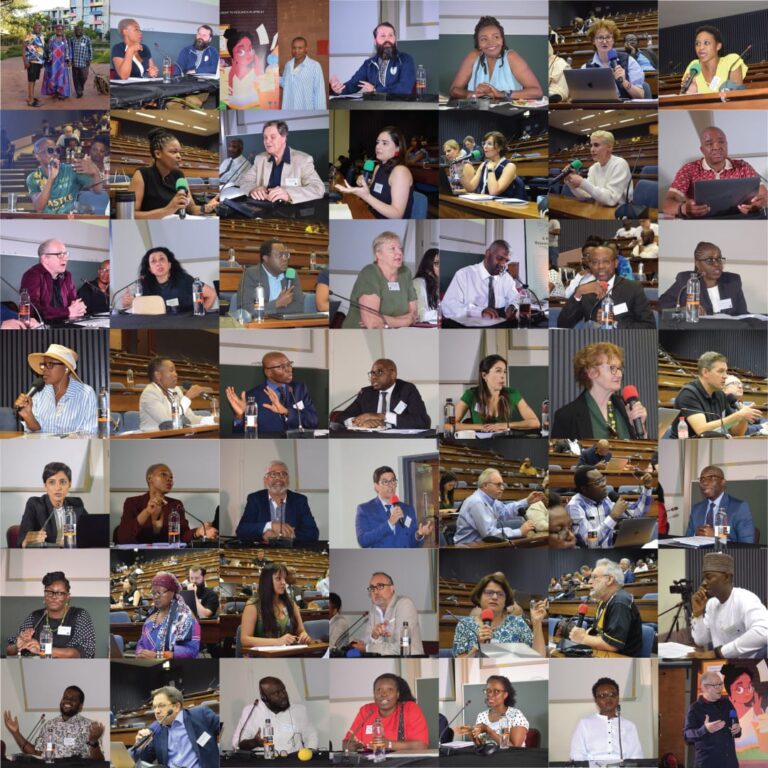
[Vitor Ido] A conference “A Right to Research in Africa? A Week of Debates on Copyright and Access to Knowledge” took place on 23-27 January 2023 at the University of Pretoria and the University of Cape Town, South Africa. The gathering of scholars, artists, librarians, researchers and government officials had the objective to discuss the evolution of copyright law and the role of limitations and exceptions (L&Es) to advance research in Africa. The week of debates was co-organized by the South Centre, ReCreate South Africa, Program on Information Justice and Intellectual Property (PIJIP) – American University Washington College of Law, Electronic Information for Libraries (EIFL), the University of Pretoria – Future Africa, the University of Cape Town – IP Unit, the Centre for Intellectual Property and Information Technology Law (CIPIT) – Strathmore University, Wikimedia Foundation and Masakhane.

Video: PROF. SEAN FLYNN GIVES A CONCEPTUAL OVERVIEW OF RESEARCH AS A HUMAN RIGHT IN INTERNATIONAL COPYRIGHT

Interested in learning more about research as a human right? In this informative video, Professor Flynn gives a conceptual overview of research as a human right in international copyright.  Further, he sheds light on the human rights aspect of the right to research and how it differs from a type of exception to copyright.  He continues to flush out how human rights duties are imposed by the state to act or refrain from acting in certain ways. He uses censorship as an example of a state affirmative action that reduces people's access to their right to research.

A Right to Research in Africa

[Sean Flynn] The Right to Research in International Copyright Project hosted a week of conferences in South Africa, January 23-27, 2023. The week of public and private meetings in Pretoria and Cape Town featured discussions of how African researchers are using modern digital technologies to address a range of pressing research questions that require use of research exceptions in copyright law. Academics, practicing lawyers and government officials from several African countries provided the legal and policy context for the researchers’ work, illuminating both the flexibility in many African laws that permit research uses, as well as  where changes in domestic and international law could serve the public interest. 

Global Civil Society Coalition Promotes Access to Knowledge

[Communia Association] Today, the A2K Coalition is launching its website with demands for education, research and cultural heritage... The members of the A2K Coalition represent educators, researchers, students, libraries, archives, museums, other knowledge users and creative communities around the globe. Our individual missions are varied but we all share a vision of a fair and balanced copyright system. Click here for more.

Reforming Copyright or Toward Another Science? A More Human Rights-Oriented Approach Under the REBSPA in Constructing a “Right to Research” for Scholarly Publishing

[Klaus Beiter] Abstract: This article identifies copyright impediments existing in the sphere of science, to then make (tentative) suggestions as to how these may be overcome. It focuses on scholarly publishing only, and here primarily on digital content, specifically asking whether expensive commercial scholarly publishers continue to “add value” to research in the digital era. The deficits of copyright law and potential solutions thereto are assessed in the light of the right of everyone “to enjoy the benefits of scientific progress and its applications” (REBSPA) as laid down in Article 15(1)(b) of the International Covenant on Economic, Social and Cultural Rights (ICESCR) of 1966. A substantial part of the discussion examines whether and, if so, in what ways, the REBSPA gives rise to a “right to research,” also in an extraterritorial sense that would require the right to be respected beyond borders, and what the normative implications of such a right would be for copyright and science.

The UK Government Moves Forward With a Text and Data Mining Exception for All Purposes

[Alina Trapova and João Pedro Quintais] As previously reported, between October 2021 and January 2022 the UK Intellectual Property Office held a public consultation on the intersection between artificial intelligence (AI) and intellectual property laws... the UK government has now decided to introduce a new copyright and database right exception which allows TDM for any purpose, i.e. including commercial uses. Licensing will no longer be an issue and rightholders will not be able to opt-out or contract out of the exception. The government believes that this approach would significantly benefit a wide range of stakeholders – from researchers, AI developers, small businesses, through cultural heritage institutions, journalists, all the way to engaged citizens.

How Patent Rights Affect University Science

[Laurent R. Bergé, Thorsten Doherr, and Katrin Hussinger] Abstract: How do intellectual property rights influence academic science? We investigate the consequences of the introduction of software patents in the U.S. on the publications of university researchers in the field of computer science. Difference-in-difference estimations reveal that software scientists at U.S. universities produced fewer publications (both in terms of quantity and quality) than their European counterparts after patent rights for software inventions were introduced. We then introduce a theoretical model that accounts for substitution and complementarity between patenting and publishing as well as for the direction of research. In line with the model’s prediction, further results show that the decrease in publications is largest for scientists at the bottom of the ability distribution. Further, we evidence a change in the direction of research following the reform towards more applied research.

An Overview of Copyright Restrictions to Legal TDM Research

[Mike Palmedo] PIJIP has been reviewing copyright laws around the world. Our detailed review is available as a PIJIP working paper in which we classify countries "based on the degree to which they have a research exception in their law that is sufficiently open to be able to permit reproduction and communications of copyrighted work needed for academic (i.e. non-commercial) text and data mining (TDM) research.” This post presents the data on copyright exceptions by restriction rather than by country. It demonstrates that wealthier countries tend to have less restrictive copyright exceptions for TDM research, relative to other countries.

Re:Create Interview with Sean Flynn

[ReCreate] For our latest Copyright Corner Q&A series installment, Re:Create spoke with Sean Flynn, Director of the American University Program on Information Justice and Intellectual Property. Flynn helps explain the meaning of “information justice,” the restrictions that continue to constrain research and education – even in today’s digital age – and how global IP laws impact access to the Covid vaccine. Flynn also helps readers better understand how the ability to make and use research materials is core to the freedom of expression and how copyright law can become an unjustifiable restriction without adequate exceptions.

WIPO SCCR 42: Statement by CIS on the Limitations and Exceptions Agenda Item

[Anubha Sinha] Thank you, Mr. Chair. I’m speaking on behalf of the Centre for Internet and Society, India. The Proposal by the African Group for a Draft work program on Exceptions and Limitations has the potential to address issues faced in the domains of access to information, culture and education, keeping in mind that there have been systemic shifts in the knowledge ecosystem since pandemic, which will endure in the long term as well.

COMMUNIA Statement to the 42nd WIPO SCCR on Limitations and Exceptions for Education and Research

[Teresa Nobre] ...There is absolutely no doubt that the restrictions copyright laws pose on access to knowledge and information condition the right to education and the right to research, and that educational and research exceptions would benefit society as a whole. That is what will determine whether teachers can show a short news report during live-streamed online classes, whether researchers can conduct medical research or track disinformation online.